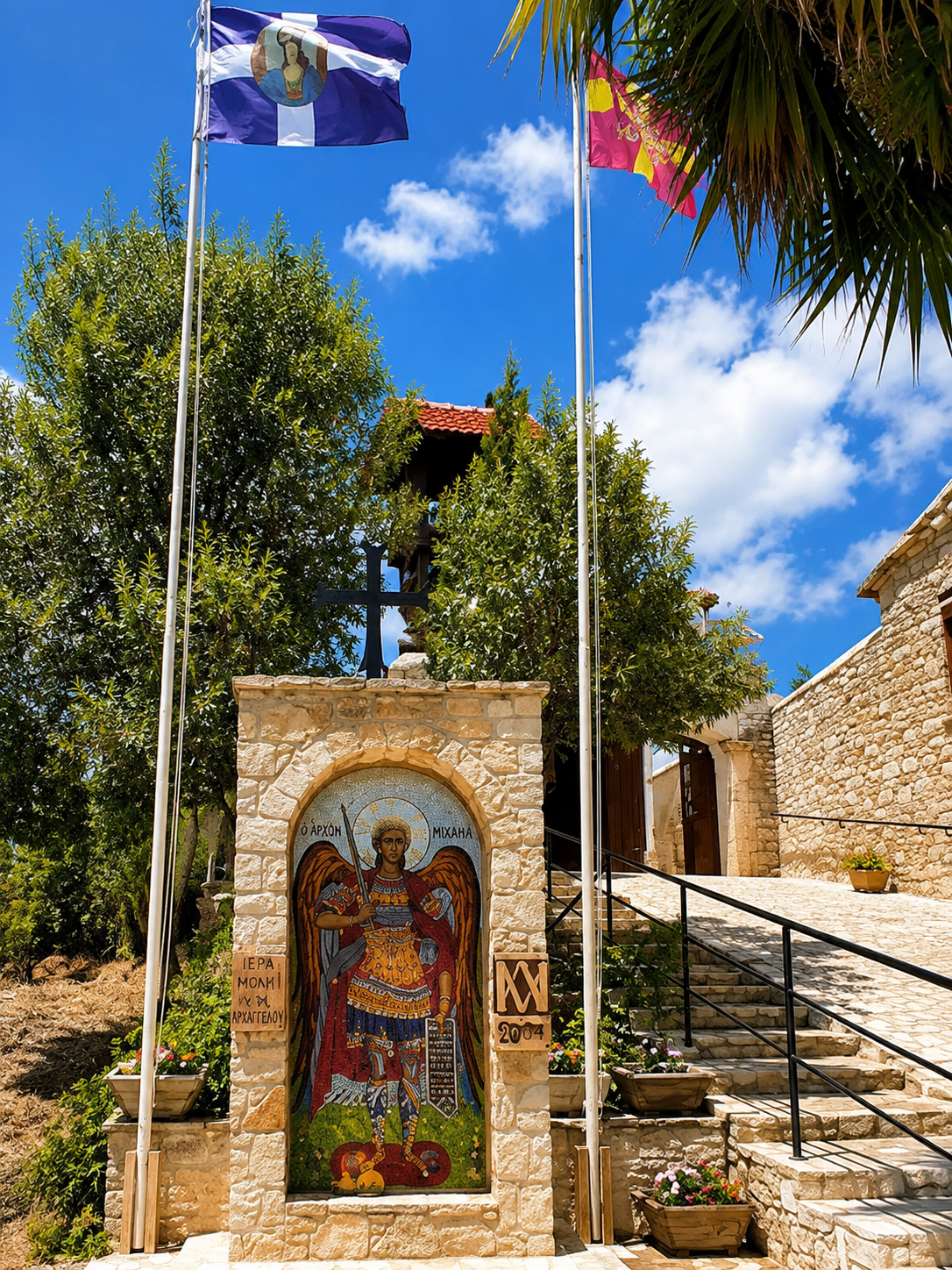
Archangel Michael
The Holy Archangel Michael is one of the most celebrated of the Angels and bodiless powers; he is called the Archistrategos, or chief commander, of all the bodiless powers. According to Holy Scripture and Tradition, he has interceded for humanity multiple times and continues to serve as the Defender of the Faith. Archangel Michael is most often invoked for protection from invasion by enemies and from civil war, and for the defeat of adversaries on the field of battle. He is celebrated primarily on November 8, the Synaxis of Archangel Michael and all the Bodiless Powers of Heaven; September 6 also marks the miracle of the Archangel at Colossae.
The Church Fathers ascribe to Archangel Michael the following events: During the Exodus of the Israelite from Egypt he went before them in the form of a pillar of cloud by day and a pillar of fire by night; the power of the great Chief Commander of God was manifest in the annihilation of the 185 thousand soldiers of the Assyrian emperor Sennacherib (4/2 Kings 19:35); also in the smiting of the impious leader Heliodorus (2 Macc. 3: 24-26); and in the protection of the Three Holy Youths: Ananias, Azarias and Misail, thrown into the fiery furnace for their refusal to worship an idol (Dan 3:22-25). Through the will of God, the Chief Commander Michael transported the Prophet Habbakuk (December 2) from Judea to Babylon, to give food to Daniel in the lions’ den (Dan. 14:33-37). The Archangel Michael disputed with the devil over the body of the holy Prophet Moses (Jude 1:9).
In New Testament times, the holy Archangel Michael showed his power when he miraculously saved a young man, cast into the sea by robbers with a stone about his neck on the shores of Mt Athos. This story is found in the Athonite Paterikon, and in the Life of St Neophytus of Docheiariou (November 9). Perhaps his most famous miracle, though, is the salvation of the church at Colossae. Here a number of pagans tried to destroy this church by diverting the flow of two rivers directly into its path. However, the Archangel appeared amongst the waters, and, carrying a cross, channeled the rivers underground so that the ground the church stood on would not be destroyed. The spring which came forth after this event is said to have special healing powers.
Archangel Michael also has been associated with healing in other cases, as well as his primary role as leader of the Church Militant. He has been said to appear to Emperor Constantine the Great (d. 337) at Constantinople, to have intervened in assorted battles, and appeared, sword in hand, over the mausoleum of Hadrian.
-
In a region of Phrygia, the earth gushed forth holy water through the power of Archangel Michael, which healed every sickness of the afflicted. A Christian, whose daughter was healed, built a beautiful church in the name of the Archistrategos, above the spring.
Ninety years later, a pious young man named Archippos came to the church. He became a servant of the church and lived an ascetic and temperate life. When the pagans saw this, they captured Archippos and beat him severely. Then, they rushed to destroy the church and the holy spring. But behold the great power of the Archangel! Some of their hands became paralyzed, while others were stopped by a barrier of fire, forcing them to return empty-handed. However, their stubbornness and anger drove them to divert a nearby river to sweep away the church and drown Archippos. But again, a miracle occurred! The river turned backward! Then they thought to combine two other rivers. But Archangel Michael appeared to Archippos and, after leading him out of the church, made the sign of the cross, and the rivers stood still like a wall. He then commanded them to be swallowed by the earth, and indeed, in a miraculous way, to this day, the waters of the rivers are absorbed into the earth at that place. That is why the place was named Chonae (meaning “funnels”).
-
Monday, January 16, 2012, 12:27
About a year ago, we visited the daughter of our friend at the Pediatric Clinic of Tzaneio Hospital in Piraeus, who had injured her leg and was hospitalized. There, we had the fortune to meet a four-year-old girl who owed her life to Archangel Michael himself. The event the girl’s parents experienced, who were deeply devout to the Archangel, was truly unbelievable.
I will now recount the incident as I heard it:
The woman (the girl’s mother) went to the maternity hospital when it was time to give birth. As usual, the father-to-be and close family members were waiting outside the operating room, anticipating the joyous event. However, after a long wait, the doctor emerged, pale and hurried, and instead of good news, he announced that the baby, while being delivered normally, suddenly got its head stuck in the birth canal and could not come out. “We are making every effort, but even if we manage to save the baby from suffocating, due to lack of oxygen, it will have suffered brain damage,” the doctor said, before rushing back into the operating room to continue the desperate attempts.
His words struck like a bolt of lightning. Everyone was stunned and didn’t know what to do. At that moment, with what little courage she could muster, the grandmother-to-be whispered to her son, “Go, my child, to the church across the street and light a candle to Archangel Michael. He can save our child.” Without a second thought, the young man ran to the church, tearfully praying to the Archangel as he lit the candle. He hurried back to see how things would turn out. And this is where the strange events began!
As he entered the hospital, an unknown orderly stopped him and said, “Don’t worry, be calm. Everything is fine. Your wife and your daughter are both safe. Everything turned out well.” The man thanked him profusely and, relieved, rushed upstairs. When he arrived at the floor, he saw everyone waiting anxiously, just as he had left them. They knew nothing about what the orderly had told him, nor had they heard anything from the doctor. While the father-to-be looked at his mother in confusion, the doctor emerged, now relieved but clearly bewildered, and said, “Everything went well, and both your wife and your baby girl are fine.” Still speaking slowly, as if in a trance, he added, “You know, something very strange happened.
As we were struggling in vain, trying to save the baby, the door to the operating room opened, and a young orderly came in, saying, ‘Step aside. I’ll deliver the baby.’ Without asking any questions or objecting, we obeyed and watched in a daze as he delivered your wife. After a short while, he was holding your healthy baby girl in his arms, without any damage at all.” The doctor spoke as if he were in shock, while the relatives and the father cried with joy and gratitude to Saint Michael, because they all understood that the mysterious orderly was none other than Him.
This was the great and wondrous miracle I heard with my own ears, and I wanted to share it with you.
My brothers and sisters, fear nothing. God is alive! The Saints and Angels are our protection and guardians, as long as we ask with faith and love for God. And let us keep something else in mind: If, sometimes, our prayer is not heard and we don’t experience such a miracle, let us NOT be scandalized, let us NOT complain, let us NOT say, “Why them and not us?” Never let such a thought cross our minds. We must always remember that when we weep, Christ weeps too, for He shed His Blood on the Cross for all of us and is the ONLY One who truly loves us. If He does not fulfill something we fervently ask for, there must be a reason. He knows far more than our poor and limited minds. We must learn to always trust His judgment and will. He is our Creator and will never abandon us, no matter what happens.
God be with us.
-
An event is reported with real names and details involving prominent and respected scientists. The incident occurred to Father Daniel Sapikas, a resident of Athens, Archimandrite, and physician. In 1976, he graduated from the Theological School of Athens, and in 1978, he was ordained a priest. In 1992, he graduated from the Medical School of the University of Athens, and that same year, he was elected an active member of the New York Academy of Sciences, being the first Orthodox clergyman to join this institution.
On February 19, 2001, during a celebratory event attended by the Archbishop of Athens, a representative of the President of the Hellenic Republic, and members of the government, he was awarded the platinum kotinos (laurel wreath) for his services to Hellenism. He recounts the following…
On April 22, 1994, I was admitted to the Eugenides Hospital with 4.5 kg of empyema in the right hemithorax, experiencing complete apnea, inability to walk, a fever of 41.5°C, and a diabetic shock of unknown cause. Through a cloud, I could see and hear what was happening in the operating room, and my greatest torment was that, as a doctor, I knew very well the critical nature of my condition…
I knew that my chances of dying were around 95%. And I was not wrong. In fact, I was even lenient in my assessment, as the medical team, consisting of Ioannis Belenis, director of Evangelismos Hospital, Professor Chrysostomos Melissinos, director of the pulmonary clinic at the Hygeia Hospital, and Irene Batali, the anesthesiologist, who was hesitant to administer anesthesia due to the risk of heart failure caused by my weight, were discussing loudly, not realizing that I could hear their words…
I could hear them giving me only a 2% chance of survival!…
“We’ll do what we can,” they said, “but the chances of survival are minimal, with a 98% chance of death! He’s doomed either way.”
At that moment, I felt completely alone… With great effort, I made the sign of the cross and prayed to my protector, the Archangel Michael.
“Archangel Michael, do not leave me, do not abandon me. You are the only one I have now, and I entrust my life to you…” A metallic sound interrupted my prayer. I was afraid I had knocked over a tool with my movements and tried to turn my head toward the sound. And then… My God!
The Archangel Michael, in full armor and holding a sword in his right hand, stood beside me, smiling and alive.
“Daniel, I am here,” he said. “I have not abandoned you. I am protecting you. I will perform the surgery, and you will be well. Do not be afraid!” Those were the words of the Archangel, and as he spoke, he touched my chest with his sword…
Soon after, Professor Belenis came in. “Let us pray together, Father Daniel,” he said to me, “and with God’s help, everything will go well.” And indeed, it did!
The surgery was successful. The hand of the doctor, guided by the Archangel, I am certain, gave me back the life that had begun to slip away from me. And today, not for the first time, I returned once again to the nationwide pilgrimage site of the Archangels in Mandamados, Lesbos, to thank Archangel Michael for saving me…
*Excerpt from the quarterly newsletter “The Archangel” of the Holy Pilgrimage of the Archangels in Mandamados, Lesbos.
-
A pilot gives thanks to Archangel MichaelIt was a spring morning in the distant land down in Sudan. At the capital’s airport, there was unusual activity. Besides the usual flights, carefree youth, students with their excursion bags, filled the airport halls. A school educational flight trip had been scheduled for that day. School songs and joyful voices broke the monotone hum of the planes taking off and landing at the airport. Suddenly, the microphones announced:
“Excursionists and their accompanying adults, please board the aircraft. The flight will take off in 5 minutes.” A stream of young people rushed into the airport and headed towards the aircraft. Within three minutes, everything was ready for takeoff. The captain, a sporty young man not far off in age from his young passengers, but an excellent student and perhaps the best and most experienced of the company, welcomed them aboard and promised them a pleasant journey. Everything was set. The captain took a last customary look at the instruments of the aircraft, communicated with the control center to say “Okay,” and started the engines. The center provided him with the latest weather information, which was very good, and wished him a good trip. In two minutes, the airplane kissed the ground for the last time and surged powerfully into the skies, like a large predatory bird, to cover the distance of 500 miles that separated them from their destination airport. The aircraft had covered approximately 100 miles, and everything indicated that they were enjoying a wonderful flight in a clear blue sky. The passengers reveled in the beautiful sight that the high altitude offered them. Below their feet, a huge relief map, alive with villages, mountains, rivers, and plains, spread out. The flight attendant continuously guided and informed them.
The captain took his turn at his little microphone to chat with the passengers and share the secrets of the aircraft and its techniques. It was indeed a magnificent journey. The captain opened the radio and requested the center for his position and the weather. The center responded in turn and informed him that no change in weather was expected until the end of their journey. He closed the radio and requested to speak to the passengers when, ahead of him, he spotted a pitch-black cloud. He closed the microphone and tightened the controls to lead the aircraft beneath the cloud and maintain the passengers’ visual contact with the ground.
It was under the cloud when a second, even darker cloud with thunder and lightning appeared before him. He had fallen into a storm! He raised the aircraft’s altitude to escape; the altimeter showed 8,000 feet, but the storm did not relent. He increased altitude again. The altimeter read 10,000 feet, the maximum endurance of his aircraft, and the passengers began to panic. Visibility was zero. Hail pounded like bullets against the aircraft’s windows. Lightning and thunder illuminated the sky like hostile artillery trying to bring them down. The flight attendant tried to calm them with poise. The aircraft, like a toy in the terrible embrace of the storm, began to creak, and the altimeter showed 12,000 feet. The captain, calm, began to lower the aircraft. 8,000 feet, 6,000 feet, 5,000 feet, 4,000 feet, 3,000 feet, 2,000 feet—the same situation! In fear of crashing into a mountain peak, he began to ascend again. He reached 8,000 feet and opened the radio to learn from the control tower his position and inform them that he had fallen into a storm, despite the good weather reports, but found that it was not working.
He immediately opened the radio; the same silence. A cold hand tightened around his heart. He opened the map and tried to determine his position on his own. A futile effort. In trying to escape the storm, he had lost his bearings. In his co-pilot’s eyes, the first signs of panic began to emerge. The captain read the anxiety in his assistant’s eyes and, before speaking to him, made one last attempt with the radio and the radio. A futile effort; the storm had strangely destroyed them! He tried again with the map, the same result. In such situations, the courage and composure of the captain yield good results. He turned to his co-pilot, who looked at him frozen, petrified, and asked him to remain calm, as their situation was very critical and they must avoid panic among the passengers. However, panic was not far from the passengers. The flight attendant, unaware of the criticality of the situation, made every honorable effort to reassure them. Indeed, the situation was very critical. The captain, without orientation, radio, or position, in the terrible storm that seemed endless, could not pilot the aircraft confidently. He began to circle and ascend and descend, trying to emerge from the tempest. The aircraft was blindly driven by the captain, who remained calm until then.
However, hours passed; they should have landed approximately two and a half hours ago and were still in the air. Fuel was running dangerously low. No help, no bright signal. The passengers, knowing in advance the time required for their journey and seeing that they were delayed far too long, burst into tears and hysteria. Even the flight attendant lost control and could offer no help to the passengers.
The captain futilely tried to encourage their morale with the microphone. The co-pilot, a wreck, incapable of offering the slightest help. In his anxiety, the captain glanced at the fuel gauge. Cold sweat drenched him. They had, at most, 20 minutes of fuel left. From that moment, he began to bend as well. He felt like crying! He held back. He was almost certain of destruction. He engaged the autopilot, leaned over the controls, and surrendered to fate. Like a cinematic scene, in those final moments, memories of his life flashed before his eyes, from his childhood. Suddenly, he was shaken. Of course! The screen of his thoughts presented Greece, Mytilene, Sycamnia. He was Greek, and his mother was from Sycamnia in Mytilene. He remembered coming as a child to visit his mother’s birthplace, Sycamnia, to meet his grandmother and relatives. He also remembered that his pious mother often spoke to him about the miraculous Archangel Michael of Mamtamados. He remembered going with her to Mamtamados as a child to venerate the miraculous icon of the Archangel.
He felt the shiver he felt then when he beheld the relief image of the Archangel. In his ears, he could still hear the words of the elders who told him: “The Black one, my child, when you call him with faith (this is what they still call the Archangel today, due to his dark image), is always near you, eager to help you; we have tangible miracles from him in wars.” He shivered! He took heart! He truly believed in the Great Helper and raising his hands high, from his heart he cried out with strength, “My Archangel, my Black one, save us, save us, and I will light a candle as tall as I am and I will hang a golden replica of our airplane for you!”
“Then, the pitch-black clouds opened before me, and the clear blue sky appeared. Just as a theater curtain rises to reveal the scene, beneath our feet, bathed in sunlight, the airport of our destination appeared. I took the controls joyfully, and soon we were landing at the airport. I glanced at the fuel gauge and noticed we had about 5 minutes of fuel left.
With the first opportunity, I took my leave, and today I am here, my Father, to express my gratitude and worship to the Saint, our savior, and to reverently present before Him my vow.
In his trembling hands appeared a golden replica of an airplane. It was his great vow. I looked at him with emotion. In his tearful eyes, one could see the satisfaction that one feels when fulfilling a great obligation. I felt my tongue heavy to speak. My eyes ached as I tried to hold back my tears. I only managed to whisper:
“With You as my protector and helper,
guardian and savior of my humble soul,
Michael Archangel and Great Archangel,
in time of danger, help me.”
Source: agiameteora.net
-
It was a Sunday in July. In Mytilene, the pilgrimage of the Archangels was receiving visitors from very early in the morning. A sea of people filled the courtyards. From the number of cars, one could tell that most of the pilgrims were from other parts of the country. The Sunday liturgy was in progress. The melodious chanters of the pilgrimage were calming the congregation with their beautiful hymns, uplifting them spiritually. Everyone was captivated by the divine service, each person focused on their innermost prayers.
Suddenly, a woman was struggling to push her way through the crowd to reach the miraculous icon of the Archangel, holding a lamb in her arms. When she reached the icon, she broke down in tears.
— “Archangel! My Savior! At last, you have granted me the opportunity to come and worship you and thank you, without help, all by myself!”
Soon, at the stairs of the office, the woman appeared contemplative.
“Father, I am very happy today. I thank the Almighty and Archangel Michael for granting me the opportunity to be here to fulfill my vow. But I better start from the beginning. My name is Niki Pantelidou, and I live on ……………… street in Evosmos, Thessaloniki. For over ten years, I was paralyzed, and recently, due to my distress, I became seriously ill, affecting my heart. The doctors told my husband that my days were numbered. I awaited the end, pinned to my bed, under the loving care of my husband.
I learned about the Archangel two years ago from the magazine “THE ARCHANGEL.” I wrote to you, if you remember, requesting an icon of the Archangel, and you sent me a small relief. From the moment I received that icon, I firmly believed that I would be healed. I prayed day and night, and as time passed, my faith grew stronger to the point where I felt certain that I would recover.
It was the eve of the Archangel’s feast day. Not on November 8th, but on the day of the Myrrhbearers, on the 15th of Pascha, when you celebrate His great feast, the consecration of His holy temple. I was alone in my room and fervently pleading for His grace. My eyes were tearful…… When, O Archangel, my Archangel!!!
Across from my bed was a wardrobe. This wardrobe slowly began to transform into a relief image, just like the one you sent me. I wiped my eyes to make sure. In front of me was indeed a gigantic relief image of the Archangel, with the Archangel ready to speak to me.
With mixed emotions of joy, hope, and awe, I instinctively tried to rise. However, my illness held me firmly pinned to my bed of pain. I began to shout loudly, knowing that at that moment, the Great and Holy One was listening to me:
— “…. Archangel, my Archangel, save me, have mercy on me, forgive me, have compassion on me, perform your miracle….!!!”
Then the Archangel smiled at me from the image. His smile began to calm me. I started to feel my eyelids heavy, and slowly I fell asleep. When my family arrived, they found me sleeping peacefully. In the early morning, the day of His feast, the Sunday of the Myrrhbearers, I woke up feeling serene, and what do I see, Father?
I see in my room the Archangel Michael in full form!!! His armor was golden, shiny, and radiated light! His wings were pure white. He was looking at me and smiling.
“…. Archangel, save me, help me, heal me, have mercy on me….”
He continued to smile at me, and it seemed as if a slight breeze made his wings shiver. Suddenly, He extended His hand to me and said:
— “…. GET UP AND GO TO MY TEMPLE, TO THE CEMETERY WHERE THE LITURGY IS CELEBRATING TODAY AND RECEIVE THE HOLY MYSTERIES…”
I took His hand and, with His help, rose. When I stood on my feet, He vanished. Something very strange was happening to me. Instead of screaming and waking everyone up, I felt a peace, a tranquility as if I had never been ill. I began to get ready, and shortly after, I set off for the church. I participated in the service and received communion, as the Archangel had told me, and returned home. Only then did I think of my family and their worry when they would find me missing from my bed. As soon as they saw me enter, they were all speechless, and it took a long time for them to recover and start asking questions. I was living a dream. I had not yet realized my condition. Many times, I would get out of bed and walk around to make sure I wasn’t dreaming. In the first few days, I felt exhausted, but slowly, with the care of my loved ones, I began to recover. Recently, feeling quite well, I decided to fulfill my vow. So here I am today with my offering, a lamb, to thank my Savior. And saying this, she stood up again and crossed herself many times.
“THE HISTORY AND MIRACLES OF THE ARCHANGEL MANDAMADOU,” Volume I
Source: briefingnews.gr